



Growing a business is exciting, but it comes with a pressure that most entrepreneurs do not talk about enough. At some point, the workload becomes too much for one person or a small team to handle, and the obvious solution feels like hiring more full-time employees. But full-time hires bring salaries, benefits, office space, onboarding time, and long-term commitment. For small businesses, especially, that kind of overhead can slow growth instead of supporting it.
This is exactly where virtual assistants come in. The role of virtual assistants in business scalability has quietly become one of the most important conversations in modern entrepreneurship. Business owners across industries are discovering that they can grow their operations, serve more clients, and increase output without the traditional cost and risk of overhiring. This blog will walk you through how that actually works, what tasks make sense to delegate, what it costs, and why more businesses are building their growth strategy around virtual support.
What Does Business Scalability Actually Mean?
Before getting into virtual assistants specifically, it helps to understand what scalability really means in a practical sense. A scalable business is one that can grow its revenue and output without a proportional increase in cost and effort. In other words, you want to be able to do more without it costing you double just to get there.
Most small business owners hit a ceiling not because of a lack of clients or opportunity, but because of operational drag. Every hour spent answering emails, scheduling appointments, managing spreadsheets, or handling customer inquiries is an hour not spent on strategy, sales, or delivering your core service. The business cannot scale when the owner is buried in tasks that do not require their specific expertise.
Scalability requires two things: the right systems and the right support. Virtual assistants provide the support side of that equation in a way that is flexible, cost-effective, and surprisingly fast to implement.
What Is a Virtual Assistant and Why Are Businesses Turning to Them?
A virtual assistant is a remote professional who provides administrative, technical, creative, or operational support to a business. They work from their own location, use their own equipment, and are typically hired on an hourly, part-time, or project basis. Unlike a full-time employee, a virtual assistant does not require benefits, office space, or a rigid employment structure.
The demand for virtual assistant services for small businesses has grown significantly over the last several years. Part of that growth came from the remote work shift during the pandemic, but most of it comes from something simpler: business owners realized that a lot of what consumed their time could be handled professionally by someone else for a fraction of the cost of a full-time hire.
There is also a skills component here that often gets overlooked. Many virtual assistants have specialized backgrounds in marketing, bookkeeping, customer service, project management, or content creation. You are not just getting someone to handle overflow tasks. You are often getting experienced professionals who bring real expertise to your business operations.
The Real Role of Virtual Assistants in Business Scalability
So what is the actual connection between hiring a virtual assistant and scaling your business? Let’s break this down in a concrete way.
When you are running a small business, your time is the most limited resource you have. Every task you handle personally is a task that takes you away from revenue-generating activities. A virtual assistant absorbs those tasks so that you can focus on what actually moves the business forward.
Think about a consultant who spends two hours every morning sorting through emails, responding to inquiries, and scheduling meetings. That is ten hours a week, forty hours a month, gone. If that consultant could recover even half of that time and redirect it toward client acquisition or service delivery, the business output would increase meaningfully without any additional overhead.
The role of virtual assistants in business scalability is fundamentally about leverage. You are leveraging someone else’s time and skills to extend your own capacity. This is how businesses grow without overhiring because you are adding capacity without adding the full financial and administrative burden of a traditional employee.
Beyond individual productivity, virtual assistants help businesses build systems. A good VA will not just do tasks. They will help create repeatable processes, document workflows, and bring consistency to operations that were previously chaotic. That kind of structural improvement is what allows a business to handle more volume without things falling apart.
Common Virtual Assistant Tasks That Directly Support Growth
One of the most common questions business owners ask is what can actually be handed off to a virtual assistant. The answer is broader than most people expect. There is a wide range of virtual assistant tasks that directly support business scalability when managed well.
Administrative Support
This is the category most people think of first, and for good reason. Calendar management, email filtering, appointment scheduling, data entry, travel booking, and document preparation are all tasks that eat time without requiring the business owner’s direct involvement. A skilled VA can manage your inbox to the point where you only see what truly needs your attention.
Customer Service and Communication
Responding to customer inquiries, following up on leads, handling complaints, and managing support tickets are all tasks that require consistency and responsiveness but do not always need to come from the owner. A virtual assistant trained in your brand voice can handle a significant volume of customer communication professionally.
Social Media Management
Creating and scheduling posts, responding to comments, monitoring engagement, and researching content ideas are all things a virtual assistant can take on. Consistent social media presence is a known driver of brand awareness and client acquisition, but it is also incredibly time-consuming when done manually.
Research and Data Analysis
Market research, competitor analysis, lead generation, and data organization are tasks that require focus and time but follow a repeatable process. Virtual assistants who specialize in research can provide business owners with the information they need to make decisions without spending hours gathering it themselves.
Bookkeeping and Financial Admin
While a virtual assistant is not a replacement for a licensed accountant, many VAs are skilled in managing invoices, tracking expenses, reconciling accounts, and preparing financial reports. Keeping the financial side of a business organized is critical for growth, and it is also one of the first things to fall through the cracks when owners get busy.
Content Creation and Marketing Support
Blog drafts, email newsletters, product descriptions, presentation decks, and marketing copy are all tasks that can be delegated to a VA with the right background. Marketing support is one of the highest-leverage areas for small businesses because consistent marketing directly feeds growth.
Project Coordination
As businesses grow, keeping track of multiple projects, deadlines, and team communications becomes its own job. A virtual assistant can serve as a project coordinator, making sure nothing slips through the cracks and that all stakeholders stay informed.
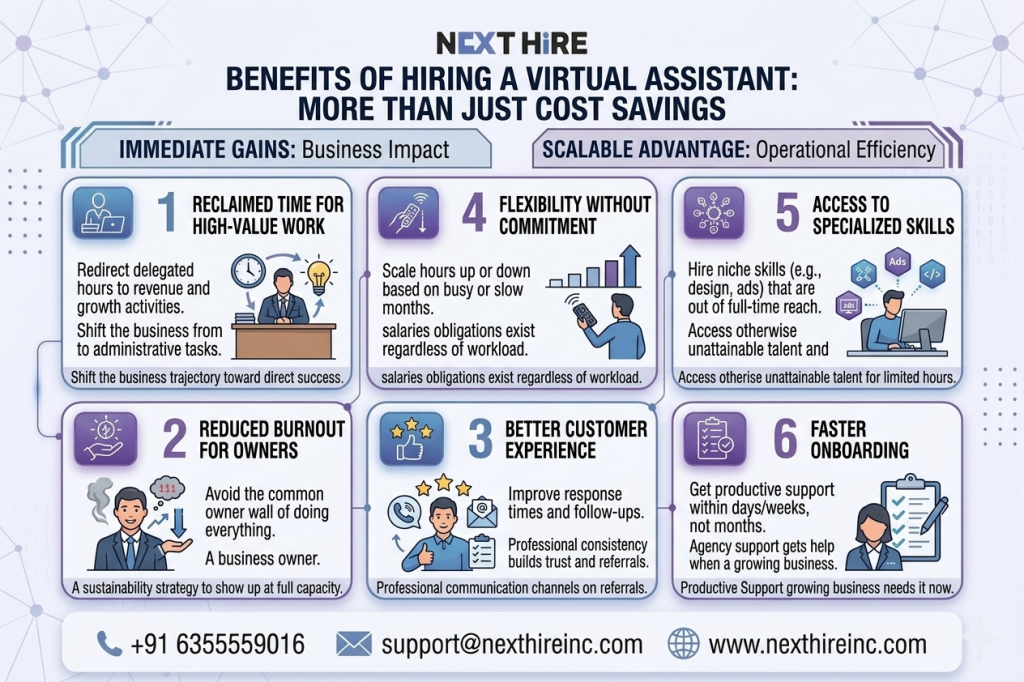
Benefits of Hiring a Virtual Assistant: More Than Just Cost Savings
The benefits of hiring a virtual assistant go well beyond just saving money, though that is certainly part of it. Let us look at the full picture of what businesses actually gain.
Reclaimed Time for High-Value Work
This is the most immediate benefit. When you stop doing tasks that can be delegated, you get hours back in your week that can be redirected toward activities that have a direct impact on revenue and growth. That shift alone can change the trajectory of a business.
Flexibility Without Long-Term Commitment
A virtual assistant relationship is inherently flexible. You can scale hours up during a busy period and pull back during slower months. This is completely different from a full-time hire where the salary obligation exists regardless of workload. For small businesses that experience seasonal fluctuations or are in a growth phase where needs are changing, this flexibility is extremely valuable.
Access to Specialized Skills on Demand
Hiring a full-time employee with a specific skill set, say, graphic design or paid advertising management, may not be financially viable for a small business. But hiring a virtual assistant with that skill set for ten or twenty hours a month is very achievable. This allows small businesses to access talent and capability that would otherwise be out of reach.
Faster Onboarding Compared to Traditional Hiring
Finding, interviewing, hiring, and onboarding a full-time employee can take months. Working with a virtual assistant, especially through a reputable agency, can get you productive support within days or weeks. When a business is in a growth phase and needs help now, that speed matters.
Reduced Burnout for Business Owners
This one does not get mentioned enough. Burnout is one of the leading reasons small businesses stall or fail. When owners try to do everything themselves, they eventually hit a wall. Delegating tasks to a virtual assistant is not just a business strategy. It is a sustainability strategy that keeps the owner capable of showing up at full capacity.
Better Customer Experience
When administrative tasks are handled well and communication is consistent, customers notice. Response times improve, follow-ups happen on schedule, and the overall experience becomes more professional. That kind of consistency builds trust and encourages repeat business and referrals.
Tasks to Outsource to a Virtual Assistant: A Strategic Framework
Knowing which tasks to outsource to a virtual assistant is a skill in itself. Not everything should be delegated right away, and not everything is appropriate for a VA. Here is a practical framework for thinking about this.
Start by identifying tasks that are repetitive and rule-based. These are your best first candidates because they follow a pattern and can be documented easily. Email sorting, social media scheduling, invoice generation, and appointment setting all fall into this category.
Next, look at tasks that are important but not urgent and not revenue-generating. Things like updating your website content, managing your CRM database, or preparing monthly reports fit here. They need to get done but they do not require your personal attention.
Then consider tasks where the main requirement is time and attention rather than specific expertise that only you have. Research projects, customer follow-ups, content editing, and inbox management are good examples.
What you should not delegate, at least not without careful thought, are tasks that require your personal judgment, involve sensitive financial decisions, or directly represent your expertise in a client relationship. There is a version of delegation that goes too far and removes the owner from things that matter. The goal is to free up your focus, not to disappear from your business entirely.
Virtual Assistant Services Cost: What to Actually Expect
One of the most practical questions business owners have is around virtual assistant services cost. The answer varies significantly depending on several factors, but it is important to have realistic expectations going in.
Independent virtual assistants found through freelance platforms typically charge anywhere from ten to thirty dollars per hour for general administrative support. Those with specialized skills in areas like bookkeeping, digital marketing, or technical project management may charge fifty dollars per hour or more.
Virtual assistant agencies, which provide vetted, trained professionals and often include management oversight, typically charge more than solo freelancers but offer greater reliability and accountability. Agency rates commonly range from twenty-five to seventy-five dollars per hour depending on the scope of work and the location of the VA.
Some businesses prefer to work on a monthly retainer model rather than hourly billing. A retainer arrangement might offer twenty hours per month for a flat fee, which makes budgeting predictable and often represents a better per-hour rate than ad hoc billing.
Here is a comparison table to give you a clear picture of how the cost options break down:
Virtual Assistant Services Cost Comparison Table
| VA Type | Hourly Rate Range | Best For | Key Consideration |
| Freelance VA (General Admin) | $10 to $25/hour | Basic admin, scheduling, data entry | Requires more management from you |
| Freelance VA (Specialized Skills) | $30 to $60/hour | Marketing, bookkeeping, design | Must vet skills independently |
| VA Agency (Standard) | $25 to $50/hour | Businesses wanting reliable, vetted help | Higher cost but better accountability |
| VA Agency (Executive/Premium) | $50 to $80/hour | Complex operations, executive support | Best for high-volume or sensitive tasks |
| Monthly Retainer Package | $400 to $2,000/month | Ongoing consistent support | Predictable budgeting, often better value |
| Offshore VA | $8 to $20/hour | High-volume, time-zone flexible tasks | Time zone and communication differences |
When calculating ROI, think about it this way. If you are billing your time at one hundred dollars per hour and you spend fifteen hours a month on tasks a VA could handle for twenty dollars per hour, you are spending three hundred dollars to get back fifteen hours worth fifteen hundred dollars of your productive time. That math makes the case clearly.
Virtual Assistant for Small Business: Specific Scenarios Where It Makes a Difference
Let us look at how a virtual assistant for small business actually plays out in real situations, because the abstract benefits are one thing and the lived experience is another.
The Solo Consultant
A business consultant running a one-person practice has a full client load but is falling behind on proposals, invoices, and follow-up communications. They hire a VA for fifteen hours a week to manage their calendar, handle client communications, prepare proposal templates, and track invoices. Within sixty days, they have taken on two additional clients because their time was freed up for sales conversations they previously could not fit in.
The E-Commerce Store Owner
A small online retailer is managing product listings, customer emails, social media, and order tracking on their own. They bring on a VA to handle customer service emails and social media scheduling. The result is faster response times, more consistent posting, and the owner getting back ten hours a week to focus on supplier relationships and new product sourcing.
The Marketing Agency
A small agency with a team of three is growing but not ready to hire another full-time employee. They bring in a VA for research, content scheduling, and client reporting. The team can now handle a larger client roster without working weekends, and the VA grows into a consistent part of the workflow without the overhead of a fourth salary.
These are not unusual examples. They reflect how businesses of different types and sizes are using virtual assistant services for small businesses to grow in a controlled, cost-effective way.
Common Mistakes to Avoid When Working With a Virtual Assistant
Even with all the potential benefits, businesses sometimes struggle to get the most out of a virtual assistant relationship. Most of these struggles come from avoidable mistakes.
Skipping the Onboarding Process
A virtual assistant is not going to read your mind. They need to be oriented to your preferences, your brand, your tools, and your expectations. Taking a week to properly onboard a VA pays dividends for months. Skipping it leads to frustration on both sides.
Delegating Without Documentation
If you want a task done a specific way, document it. Create a simple standard operating procedure, even if it is just a few bullet points and a screen recording. VAs work best when they have clear instructions to follow rather than guessing at your preferences.
Micromanaging After Delegating
One of the most common traps is delegating a task and then hovering over every step. If you have hired a qualified VA and given them clear instructions, give them room to work. Schedule check-ins at reasonable intervals rather than constantly interrupting the workflow.
Expecting Immediate Perfection
There is always a learning curve. The first few weeks of working with a new VA involve calibration. Provide feedback, be specific about what needs to change, and give the relationship time to develop before making a judgment call.
Treating It as a One-Off Solution
The most effective use of a virtual assistant comes from a consistent, ongoing relationship. The longer a VA works with your business, the better they understand your needs, your preferences, and your clients. Businesses that cycle through VAs constantly never get the compounding benefit of that institutional knowledge.
How to Get Started With a Virtual Assistant Through NextHire
If you have gotten to this point and you are thinking about what it would actually look like to bring a virtual assistant into your business, the good news is that starting is simpler than most people expect.
At NextHire, we specialize in connecting businesses with skilled, vetted virtual assistants who are matched to your specific needs. Whether you need someone to handle general administrative support, customer communication, marketing tasks, or project coordination, we work with you to find the right fit rather than just assigning whoever is available.
The process starts with understanding what you actually need. We have worked with enough small businesses to know that most owners have a hard time articulating exactly what to delegate at first. That is fine. We help you think through your workflow, identify where your time is being consumed unnecessarily, and build a delegation plan that makes sense for where your business is right now.
From there, we handle the matching, the initial vetting, and the coordination to make sure the relationship starts on solid ground. You do not have to spend weeks posting jobs, reviewing applications, and running interviews. We do that work so you can stay focused on your business.
Final Thoughts: Growth Without the Growing Pains
The narrative around hiring has always been that growth requires more employees. But that thinking leads to bloated overhead, complicated HR processes, and a cost structure that puts pressure on revenue before it even has a chance to build.
The role of virtual assistants in business scalability is reshaping that narrative for good reason. Businesses that embrace strategic delegation are finding that they can grow faster, operate more efficiently, and maintain the flexibility they need to adapt as conditions change.
Virtual assistant services for small businesses are no longer a niche workaround. They are a legitimate, sustainable growth strategy that deserves serious consideration from any business owner who wants to scale without the risk and cost of overhiring.
If you are ready to explore what that could look like for your business, NextHire is here to help you take the next step with confidence.